


Humane Flying Squirrel Removal & Exclusion
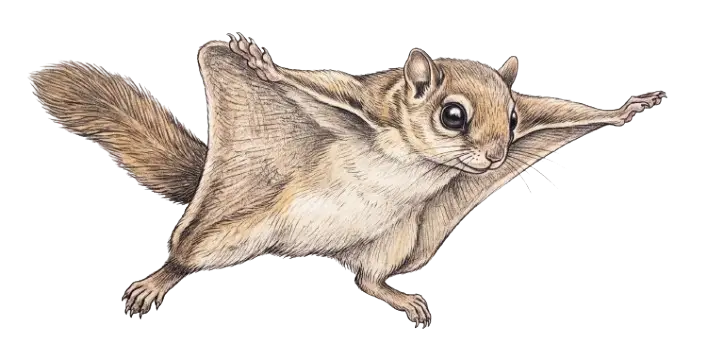
Southern flying squirrels are common throughout Western North Carolina and, unlike gray squirrels, they’re nocturnal, so most homeowners hear them scratching in the attic at night long before they ever see one. They den in colonies, which means one entry point can mean a dozen or more animals in the attic at once. Go On, Git! handles flying squirrel exclusions with the same biology-based, structural approach we use for every species, with one extra step: confirming which flying squirrel we’re dealing with.
Why Colony Size Makes Trapping a Poor Fix
Flying squirrels den communally, often with 10 to 20 animals sharing a single attic space, especially in colder months. A few snap traps or a single cage barely make a dent, and every animal left behind can still get in and out through the same gap. Here’s what that means in practice:
- Partial Removal Doesn’t Work: Trapping a handful of animals out of a colony still leaves the entry point open and scent-marked, so the remaining squirrels, and any newcomers, stay right where they are.
- Nocturnal Activity Hides the Real Scope: Because they’re active at night, homeowners often underestimate how many animals are actually denning in the space until a full inspection is done.
- The Only Fix Is Structural: The entry gap, not the animal count, is the problem. Sealing it permanently is what actually stops the cycle.
Our Colony Exclusion Process
Because an entire colony can be using the same entry points, we install one-way exit devices sized for the full group, not a single animal, so every squirrel can leave to forage and none can re-enter. Once the space is confirmed empty, we permanently seal the gap with corrosion-resistant metal mesh and flashing, the same standard we hold for every species.
Southern flying squirrels can be relocated off-site to private land in North Carolina, but only with the explicit written or verbal permission of the landowner receiving them. We handle that coordination directly when relocation is the right call.
ELEVATION RULES
A FEDERALLY ENDANGERED LOOK-ALIKE
The Northern Flying Squirrel is a federally endangered species found above 4,500 feet in Western North Carolina, and it looks very similar to the common Southern flying squirrel at a glance.
OUR VERIFICATION STEP
If your home sits above 4,500 feet, we confirm the species before any hands-on eviction or trapping. If a Northern Flying Squirrel is present, a federal depredation permit through USDA Wildlife Services is required before we proceed, and we coordinate that process directly.
How do I know if it’s flying squirrels and not regular gray squirrels?
Flying squirrels are nocturnal, so you’ll typically hear scratching and activity at night rather than during the day. They also den communally, so one entry point can mean a dozen or more animals rather than just one or two.
Can flying squirrels be relocated instead of excluded?
Southern flying squirrels, the common species here, can be relocated off-site with the landowner’s permission. We still confirm the species first, since the Northern Flying Squirrel above 4,500 feet is federally protected and handled differently.
Begin with a Wildlife Safety Assessment
Every project starts with a detailed $149 Wildlife Safety Assessment and Consultation. Our licensed Wildlife Control Agents perform a safety walk-through of your property, deploy thermal imaging to check nesting spaces, and deliver a custom structural sealing proposal. The $149 fee is credited 100% back toward your exclusion service.