


Rabies is rare in people, but it’s not rare in Western North Carolina wildlife, and it’s the real reason behind rules that can otherwise seem strict: why a raccoon can’t just get driven down the road, why a bat found in a bedroom needs to be tested instead of released out the window. Here’s what’s actually true, and what to do if it applies to you.
What Rabies Actually Is
Rabies is a virus that attacks the central nervous system. It spreads through the saliva of an infected mammal, almost always through a bite, though a scratch or a lick on an open wound or the eyes can also transmit it. Once symptoms appear, it’s nearly always fatal, in animals and in people. The upside is that it’s also almost entirely preventable if it’s treated before symptoms start, which is why what you do in the hours after a possible exposure matters more than almost anything else here.
Why There’s a Window to Act At All
Most viruses that reach the bloodstream start doing damage fast. Rabies is unusual because it travels slowly, moving from the bite site through the peripheral nerves toward the brain rather than through the blood. That trip can take anywhere from a few days to several months depending on where the bite happened and how far it is from the head, and it’s the reason post-exposure treatment works at all. The vaccine and immune globulin give your body a head start on building immunity before the virus finishes that trip. Once it reaches the brain and symptoms start, that window has closed, which is exactly why doctors don’t wait around to see if you’ll show symptoms before treating a real exposure.
The numbers back this up in a pretty striking way. In 1938, the United States reported over 9,000 rabid domestic animals and only a handful of wild ones. By 2017, that had almost completely flipped, wild animal cases numbering in the thousands while domestic cases dropped to under 400, mostly thanks to widespread pet vaccination.
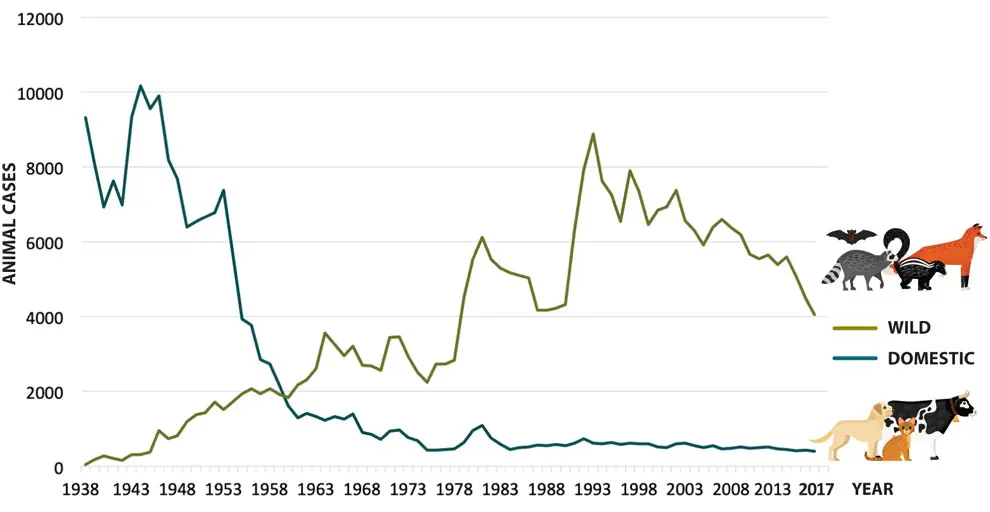
Source: CDC Vital Signs, “Then & Now: Changes in Rabid Animals Reported”, June 2019. Public domain, U.S. Centers for Disease Control and Prevention.
That shift is exactly why North Carolina requires dogs, cats, and ferrets to be vaccinated starting at four months old (N.C. General Statute 130A-185). It’s also why the actual risk left standing is almost entirely a wildlife problem now, not a pet problem.
Which Animals Around Your House Are Actually a Rabies Risk
Nationally, wildlife accounts for more than 90% of confirmed animal rabies cases, and it breaks down fairly consistently by species: bats around 35%, raccoons around 29%, skunks around 17%, and foxes around 8%, according to the CDC and the annual national surveillance report published in the Journal of the American Veterinary Medical Association. But which variant shows up depends heavily on where you live. Raccoon-variant rabies dominates the entire Eastern Seaboard, including North Carolina, while skunk variants are more common through the Midwest and fox variants cluster in parts of the Northeast and Alaska.
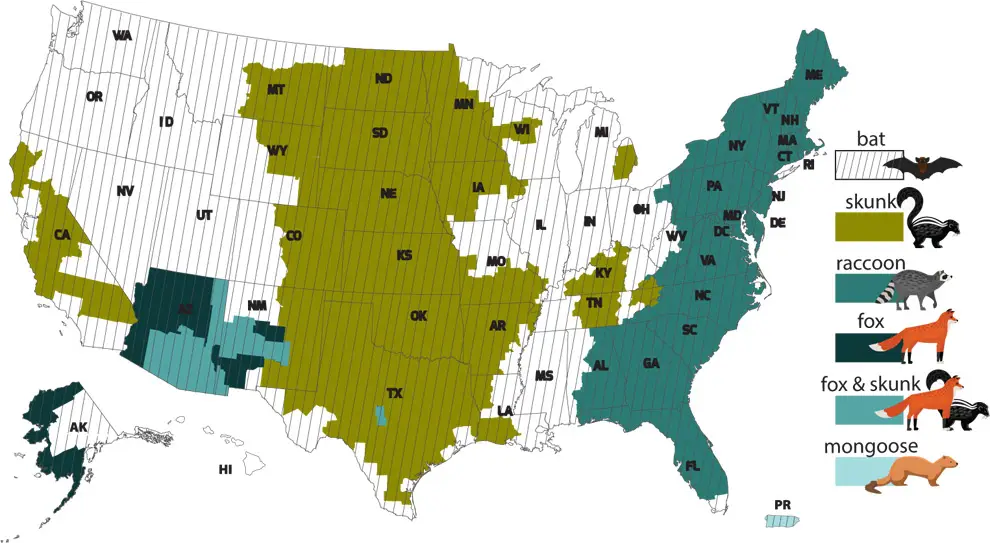
Source: CDC Vital Signs, “Common Carriers of Rabies by Location in the US”, June 2019. Public domain, U.S. Centers for Disease Control and Prevention.
Raccoon-variant rabies is present in the raccoon population in essentially every county in North Carolina, including Buncombe. Not every animal that ends up in your attic or crawlspace carries that same risk, though. Opossums are a good example: they’re not considered a rabies vector species at all, largely because their body temperature runs too low for the virus to take hold easily. Our opossum relocation page gets into why that species gets handled differently from the ones above.
Signs a Wild Animal Might Actually Be Sick
Foaming at the mouth gets all the attention, but it’s actually one of the less reliable signs, and plenty of rabid animals never show it at all. What’s more useful is behavior that doesn’t match the species. A raccoon or fox wandering around in broad daylight, moving like it’s drunk, circling, or showing no fear of people or pets, is a bigger red flag than anything happening with its mouth. So is an animal that’s unusually aggressive for no reason, or one that’s oddly calm and lets you get close when a healthy wild animal never would. Partial paralysis, especially in the hind legs, and self-mutilation at a bite site are also documented signs.
None of that means every daytime raccoon sighting is a rabies case. Raccoons will occasionally forage during the day, especially a mother with hungry young to feed. It’s the combination of odd behavior and a species that’s normally nocturnal and wary of people that’s worth taking seriously, not any one sign by itself. If you see it, keep people and pets away and call your county animal control rather than approaching.
Why We Can’t Just Relocate a Raccoon, Skunk, or Fox Down the Road
This is the question we get asked most, usually by someone who assumes trapping and driving an animal to a park is the humane option. For rabies vector species, it’s actually the opposite. Moving an animal that could be carrying rabies into a new territory risks spreading the virus into a population that hasn’t been exposed to it, on top of the stress and territorial conflict it creates for the animal itself.
That’s why North Carolina requires raccoons, skunks, and foxes taken under a Wildlife Control Agent license to be released on site or humanely euthanized, never relocated to a new property. Our raccoon, skunk, and fox pages cover how one-way eviction and structural sealing work around that rule, without ever needing to trap and transport the animal in the first place.
If You’re Bitten or Scratched
- Wash the wound thoroughly with soap and water for a full 15 minutes. The North Carolina Department of Health and Human Services lists this as the first step, before anything else.
- Call your county health department and report the bite. They’ll help determine whether the animal needs to be tested and whether you need post-exposure treatment.
- Get medical attention right away rather than waiting to see if symptoms show up. Post-exposure treatment works extremely well, but only if it starts before symptoms begin.
That last point is worth sitting with. Fewer than 10 people die of rabies in the entire United States in a typical year, and nearly all of those deaths trace back to someone who didn’t seek care soon enough after a bite. Roughly 100,000 Americans get post-exposure treatment annually, and it works. Rabies is one of the few diseases that’s almost entirely preventable after exposure, as long as you don’t wait.
If Your Pet Was Bitten or Got Into It With Wildlife
A dog that corners a raccoon under the deck or a cat that comes home with a fresh scratch needs the same seriousness as a human exposure. Call your vet and your county animal control right away, even if the wound looks minor. If your pet’s rabies vaccination is current, which North Carolina law requires for dogs, cats, and ferrets starting at four months, they’ll likely just need a booster and a short observation period at home. If the vaccination has lapsed, the observation period is longer and more involved, and in some cases state guidelines call for strict confinement or, in the worst scenario, euthanasia and testing. Keeping vaccinations current isn’t just a legal box to check, it’s genuinely the difference between a simple booster shot and a much harder outcome.
If You Find a Bat In a Room Where Someone Was Sleeping
This one surprises people. A bat bite can be small enough that it doesn’t wake someone up or leave an obvious mark, so the standard public health guidance is to treat any bat found in a room with a sleeping person, a young child, or anyone with a cognitive impairment as a possible exposure, even if no one remembers being bitten. The recommendation isn’t to open a window and let it fly out. It’s to safely contain the bat, without touching it directly, and get it tested.
Statewide testing has found that fewer than 3% of bats submitted for testing in North Carolina actually carry rabies, so the odds are in your favor. But that’s also exactly why testing the specific bat matters more than guessing. Our bat exclusion page covers what a safe, humane bat encounter should look like, and how that’s different from what we do for an active roost in an attic.
The Bigger Picture
Rabies isn’t a reason to panic about wildlife around your property, and it isn’t a reason to reach for poison or a kill trap either, since neither of those actually addresses how the animal got in or keeps the next one out. It’s the reason behind rules that can otherwise feel arbitrary, and it’s part of why structural exclusion, sealing the entry points so animals can’t get in or back in, matters more than any one-time removal. If you’re hearing movement in the attic or under the house, our crawlspace guide and attic guide can help narrow down what’s actually up there before anyone needs to handle it directly.
How long does it take for rabies symptoms to appear after a bite?
It varies widely, anywhere from about a week to several months, depending on where the bite occurred and how far the virus has to travel to reach the brain. This is exactly why post-exposure treatment can’t wait for symptoms, once they start, it’s usually too late.
Can rabies be cured once symptoms start?
No. Once symptoms begin, rabies is almost always fatal, in both animals and people. That’s why post-exposure treatment is given as a preventive measure immediately after a bite or scratch, before any symptoms appear, rather than as a cure afterward.
Is it safe to touch a dead bat or other dead animal?
No, never with bare hands. The virus can still be present in saliva or nervous tissue. Use gloves or a shovel to move it, or call animal control, and wash your hands thoroughly afterward regardless.
Sources: CDC, Rabies in the United States: Protecting Public Health; Boutelle et al., “Rabies Surveillance in the United States During 2023,” Journal of the American Veterinary Medical Association 263(10):1310-1317, 2025; NC Department of Health and Human Services, Rabies; CDC Vital Signs, “Then & Now: Changes in Rabid Animals Reported” and “Common Carriers of Rabies by Location in the US,” June 2019; NC Wildlife Resources Commission, Species Tips and WCA Rules reference.
Begin with a Wildlife Safety Assessment
Every project starts with a detailed $149 Wildlife Safety Assessment and Consultation. Our licensed Wildlife Control Agents perform a safety walk-through of your property, deploy thermal imaging to check nesting spaces, and deliver a custom structural sealing proposal. The $149 fee is credited 100% back toward your exclusion service.